
Visual Audio Splitter & Joiner
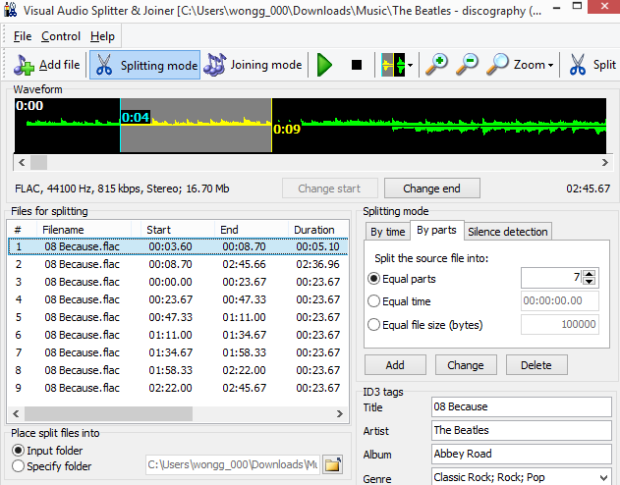
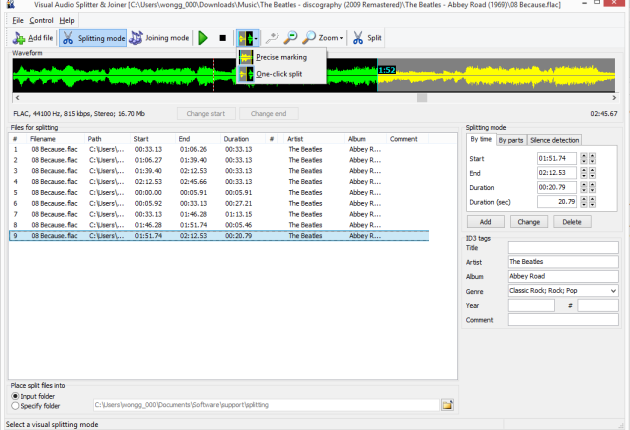
A handy software utility that can split and combine audio files. Cut files fast and easy using the waveform without losses in quality.


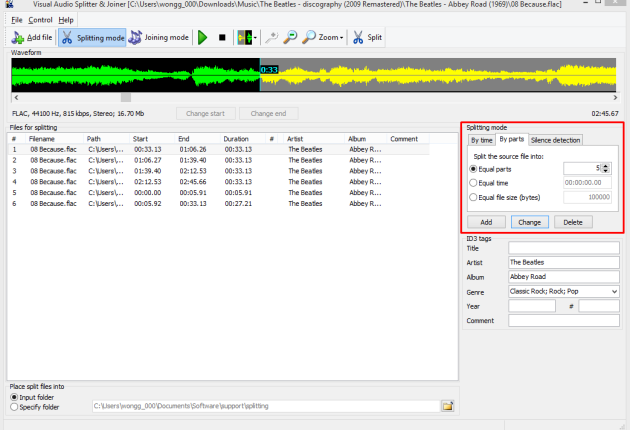
Split MP3, WMA, APE, and WAV files by a number of equal parts, by size, by duration. All the supported formats are split directly, without conversion!



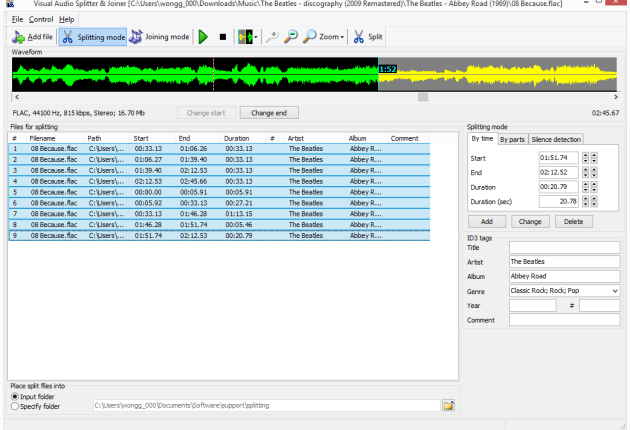
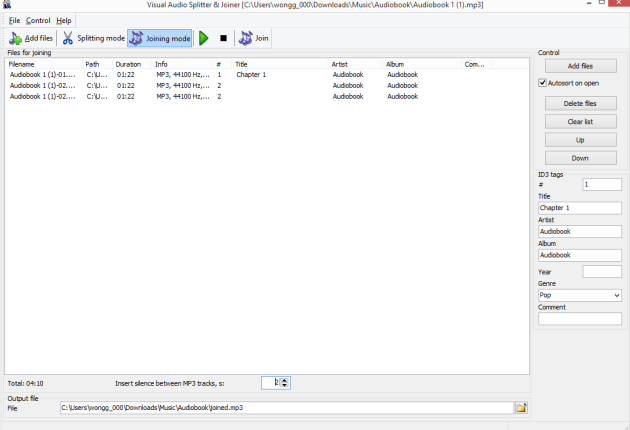
Visual Audio Splitter & Joiner allows you not only to split multiple audio files at once but also in any order. Join MP3, APE, WMA, and WAV files in any succession. Note that only parts in the same format can be merged. So if you want to merge files in different formats, you can convert them to the desired output format with AudioConverter Studio.

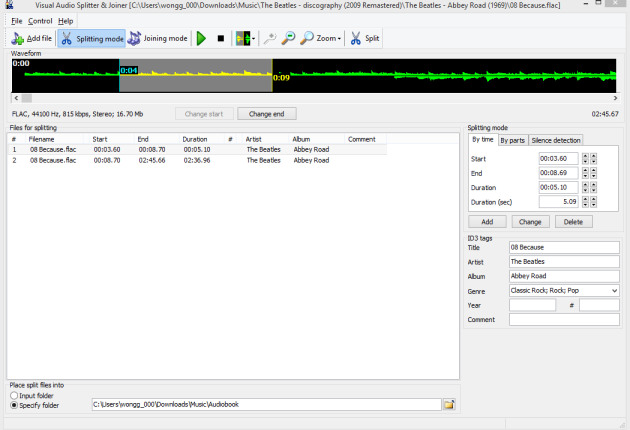
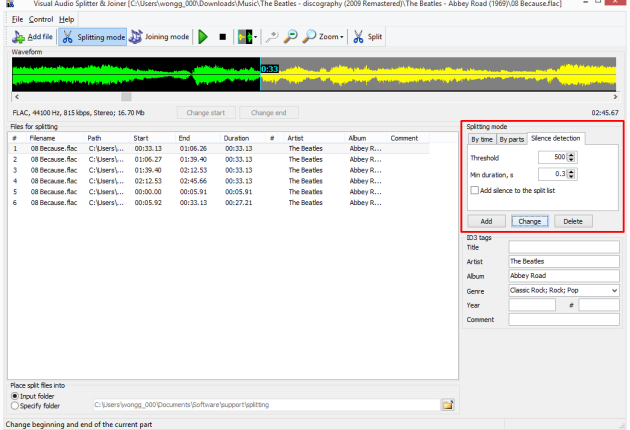
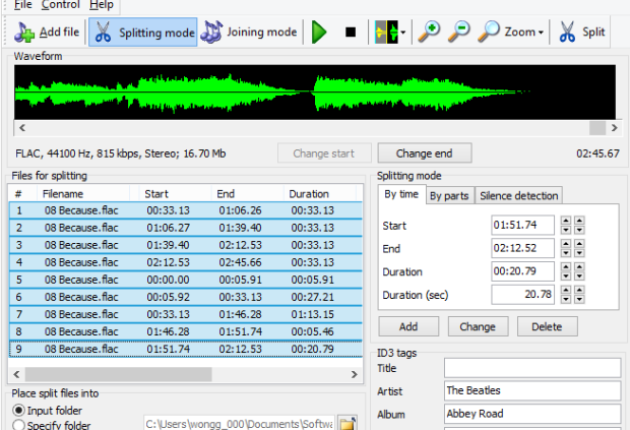
Suppose that you have an album of your favorite band in a single file and want to get easy access to each song. Visual Audio Splitter & Joiner is the right tool for this. In just a few seconds it will detect pauses between songs using the silence detection feature. All you need to do is to click the “Split” button. The MP3 splitter will deliver the result in virtually no time.

CUE files can be also used with media players. Nowadays many media players support CUE sheets either by using plugins or by initial design. CUE sheet is a simple text file (in ASCII encoding) which contains information concerning how audio tracks should be laid out on a CD.
Visual Audio Splitter & Joiner will help you create CUE sheets that will retain the detailed information. In this case, you don’t actually split the file but merely save the information about its parts into a CUE file.


Visual Audio Splitter & Joiner is so fast that you might ask: “Is it good for my files?”. The funny thing is, however, that Visual Audio Splitter & Joiner has absolutely no impact on quality.
The dub’s critical failure lies not in its mechanics but in its interpretation. Tony Jaa’s performance as Ting is defined by a quiet, almost spiritual innocence. His Thai dialogue is sparse and delivered with a low, earnest gravity that makes his sudden, violent eruptions of combat startlingly effective. The English dub, however, frequently replaces this quiet dignity with generic, Westernized grunts and one-liners that feel lifted from a 1980s Chuck Norris film. The voice actor assigned to Jaa lacks the specific timber of his voice, making Ting sound older, world-weary, and sarcastic—character traits directly at odds with his on-screen persona.
The most profound consequence of the English dub is its erasure of cultural context. Ong-Bak is deeply embedded in Thai Buddhist tradition and rural identity. The original film’s quiet moments—the blessing of the warriors, the reverence for the village elders—are not filler; they are the thematic anchors that give the violence meaning. The English dub, in its rush to get to the next chase sequence, often flattens these scenes. Subtle spiritual dialogues become mundane explanations, and local idioms are replaced with generic English phrases. This treatment implicitly tells the viewer that the "culture" is secondary to the "action," a patronizing assumption that reduces a rich Thai folk epic into a generic "revenge" template. By removing the linguistic and cultural specificity, the dub inadvertently suggests that the only thing of value in Ong-Bak is its athleticism. Ong Bak English Dub
Ultimately, watching Ong-Bak dubbed in English is akin to viewing a classical painting through a smudged, tinted window. You can still see the major shapes and colors, but the texture, the light, and the emotional intent are distorted. The physicality of Tony Jaa remains transcendent in any language; a flying knee strike needs no translation. However, the rest of the film—the spiritual journey, the cultural stakes, the nuanced performance—is compromised. For the casual viewer seeking a mindless "action flick," the English dub is serviceable. But for anyone seeking to understand why Ong-Bak is considered a landmark of world cinema, the original Thai with subtitles is the only valid choice. The dub’s critical failure lies not in its
When Ong-Bak: Muay Thai Warrior exploded onto international screens in 2003, it did more than introduce the world to Tony Jaa; it reintroduced audiences to the raw, unbridled power of practical stunt work. Directed by Prachya Pinkaew, the film is a visceral experience—a tapestry of bone-crunching elbows, breathtakingly dangerous leaps, and a narrative stripped to its mythic essentials. For purists, the film is best experienced in its original Thai language with subtitles. However, for a significant portion of its Western audience, the first encounter with Ting, the stoic village hero, came through the film’s English dub. While often maligned by critics, the Ong-Bak English dub serves as a fascinating case study in cinematic localization, revealing the deep cultural and tonal compromises required to sell a foreign-language action film to an English-speaking market. The English dub, however, frequently replaces this quiet
To understand the dub, one must first understand the commercial landscape of early 2000s North American and British home video markets. At the time, subtitled films were largely perceived as niche art-house fare, not mainstream action entertainment. Distributors like Magnet Releasing and Fox Home Entertainment operated under the assumption that the core demographic—young men seeking adrenaline-fueled escapism—would reject reading text during high-octane fight sequences. The English dub was, therefore, a calculated business decision. Its primary goal was accessibility: to allow a viewer to focus entirely on the stunning choreography of the Muay Thai fights without their gaze flicking to the bottom of the screen. In this purely functional sense, the dub succeeds. The dialogue is clear, the sync is passable, and the plot—a sacred ong bak (Buddha statue) head is stolen, and a naive warrior must retrieve it from the criminal underbelly of Bangkok—remains intact.
The English dub of Ong-Bak: Muay Thai Warrior is a monument to a bygone era of film distribution—one where domestic markets feared foreign languages. It is a functional, if artistically flawed, artifact that prioritizes adrenaline over authenticity. While it may have successfully introduced Tony Jaa’s incredible physicality to a wider audience, it did so at the cost of his character’s soul. The dub serves as a powerful lesson for modern viewers: in the translation from Thai to English, Ong-Bak does not lose its story, but it does lose its spirit. For the true warrior’s journey, the subtitles must remain on.
More detrimental is the treatment of supporting characters, particularly the comic relief, George (Petchtai Wongkamlao). In the original Thai, George’s humor is rooted in a specific blend of desperation and Thai cultural mannerisms. The English dub often amplifies his dialogue, turning his cunning survival instincts into buffoonish American-style frat-boy jokes. The tonal whiplash is jarring: one moment, the audience is witnessing a breathtaking, balletic display of violence; the next, they are subjected to a cartoonish voice that seems to belong to a different film entirely.