Furthermore, the ethical dimension extends beyond legality and safety. Small software developers, especially those creating niche educational tools, rely on sales revenue to sustain their products. Soni Typing Tutor, while not as dominant as giants like TypingMaster or Mavis Beacon, serves a dedicated user base. Every unauthorized activation represents a lost sale that could have funded a future update or a new feature. By circumventing payment, the user devalues the very tool they seek to benefit from. The long-term result is a market where developers abandon standalone software in favor of subscription-based, always-online models that are harder to pirate—a trend that ultimately harms consumers who are willing to pay.

In conclusion, while the search for a “Soni Typing Tutor activation key 6.1.63” may begin with an innocent desire to learn, it leads to a thicket of legal, security, and ethical problems. Activation keys are not arbitrary obstacles; they are the legitimate mechanism by which users and developers enter into a fair exchange of value. The true shortcut to typing mastery is not a cracked key but consistent practice—whether on a paid, free, or open-source platform. Respecting software licensing is not just about following rules; it is about building a digital culture where good work is rewarded, security is maintained, and learning is pursued honestly.

Legitimate activation keys serve a crucial function in the software ecosystem. When a user purchases Soni Typing Tutor 6.1.63, they receive a unique alphanumeric code that unlocks the full version. This system is not merely a barrier; it is a contract. It ensures that developers receive compensation for countless hours of design, coding, testing, and support. For the user, a valid key provides guaranteed access to updates, technical assistance, and a malware-free experience. In the case of typing tutors, full access typically unlocks essential features such as custom lessons, performance analytics, and the removal of distracting advertisements—tools that transform the software from a basic demo into a serious learning platform.

So what is the ethical and practical alternative? The legitimate path offers several options. First, users can purchase a license for Soni Typing Tutor 6.1.63 directly from the publisher or authorized resellers. Given that such typing tutors are typically priced between $10 and $30, this is a modest investment in a lifelong skill. Second, if the cost is prohibitive, users can explore high-quality free and open-source alternatives. Software like Klavaro, TIPP10, or even free web-based services like TypingClub and Ratatype provide robust typing instruction without any activation key required. These tools are supported by donations, open-source communities, or non-intrusive advertising, respecting both the user’s wallet and the developer’s rights.

Instead, I can offer a , using Soni Typing Tutor as a case study. The Legitimate Path to Skill: Why Activation Keys Are Not a Shortcut In an increasingly digital world, typing proficiency is no longer a niche office skill but a fundamental literacy. From students composing essays to programmers writing code, the ability to type quickly and accurately directly impacts productivity and cognitive flow. Software like Soni Typing Tutor (version 6.1.63) represents a category of educational tools designed to systematically improve these skills through drills, games, and progress tracking. However, the mention of an “activation key” for such software often leads users down a problematic path: the search for unauthorized access. A responsible examination reveals that while activation keys are a legitimate part of software distribution, seeking them outside official channels undermines both the user and the developer.

The widespread internet search for a free “Soni Typing Tutor activation key 6.1.63” reveals a common but misguided impulse: the desire to acquire value without cost. Users may argue that a typing tutor is a minor tool, not worth a purchase, or that they are simply “testing” it. However, this rationalization ignores the legal and practical consequences. First, using an unauthorized key constitutes software piracy, a violation of copyright law that can result in civil liability. Second, and more immediately dangerous, activation key generators and cracked versions are a favorite vector for malware. Cybersecurity firms consistently report that keygens and cracks for popular utilities like typing tutors are laden with trojans, keyloggers, and ransomware. Ironically, a user seeking to improve their computer proficiency by learning to type may end up compromising their entire system’s security.
Related posts

Soni Typing Tutor Activation Key 6.1.63 (2025)

Furthermore, the ethical dimension extends beyond legality and safety. Small software developers, especially those creating niche educational tools, rely on sales revenue to sustain their products. Soni Typing Tutor, while not as dominant as giants like TypingMaster or Mavis Beacon, serves a dedicated user base. Every unauthorized activation represents a lost sale that could have funded a future update or a new feature. By circumventing payment, the user devalues the very tool they seek to benefit from. The long-term result is a market where developers abandon standalone software in favor of subscription-based, always-online models that are harder to pirate—a trend that ultimately harms consumers who are willing to pay.

In conclusion, while the search for a “Soni Typing Tutor activation key 6.1.63” may begin with an innocent desire to learn, it leads to a thicket of legal, security, and ethical problems. Activation keys are not arbitrary obstacles; they are the legitimate mechanism by which users and developers enter into a fair exchange of value. The true shortcut to typing mastery is not a cracked key but consistent practice—whether on a paid, free, or open-source platform. Respecting software licensing is not just about following rules; it is about building a digital culture where good work is rewarded, security is maintained, and learning is pursued honestly. soni typing tutor activation key 6.1.63

Legitimate activation keys serve a crucial function in the software ecosystem. When a user purchases Soni Typing Tutor 6.1.63, they receive a unique alphanumeric code that unlocks the full version. This system is not merely a barrier; it is a contract. It ensures that developers receive compensation for countless hours of design, coding, testing, and support. For the user, a valid key provides guaranteed access to updates, technical assistance, and a malware-free experience. In the case of typing tutors, full access typically unlocks essential features such as custom lessons, performance analytics, and the removal of distracting advertisements—tools that transform the software from a basic demo into a serious learning platform. Every unauthorized activation represents a lost sale that

So what is the ethical and practical alternative? The legitimate path offers several options. First, users can purchase a license for Soni Typing Tutor 6.1.63 directly from the publisher or authorized resellers. Given that such typing tutors are typically priced between $10 and $30, this is a modest investment in a lifelong skill. Second, if the cost is prohibitive, users can explore high-quality free and open-source alternatives. Software like Klavaro, TIPP10, or even free web-based services like TypingClub and Ratatype provide robust typing instruction without any activation key required. These tools are supported by donations, open-source communities, or non-intrusive advertising, respecting both the user’s wallet and the developer’s rights. In conclusion, while the search for a “Soni

Instead, I can offer a , using Soni Typing Tutor as a case study. The Legitimate Path to Skill: Why Activation Keys Are Not a Shortcut In an increasingly digital world, typing proficiency is no longer a niche office skill but a fundamental literacy. From students composing essays to programmers writing code, the ability to type quickly and accurately directly impacts productivity and cognitive flow. Software like Soni Typing Tutor (version 6.1.63) represents a category of educational tools designed to systematically improve these skills through drills, games, and progress tracking. However, the mention of an “activation key” for such software often leads users down a problematic path: the search for unauthorized access. A responsible examination reveals that while activation keys are a legitimate part of software distribution, seeking them outside official channels undermines both the user and the developer.

The widespread internet search for a free “Soni Typing Tutor activation key 6.1.63” reveals a common but misguided impulse: the desire to acquire value without cost. Users may argue that a typing tutor is a minor tool, not worth a purchase, or that they are simply “testing” it. However, this rationalization ignores the legal and practical consequences. First, using an unauthorized key constitutes software piracy, a violation of copyright law that can result in civil liability. Second, and more immediately dangerous, activation key generators and cracked versions are a favorite vector for malware. Cybersecurity firms consistently report that keygens and cracks for popular utilities like typing tutors are laden with trojans, keyloggers, and ransomware. Ironically, a user seeking to improve their computer proficiency by learning to type may end up compromising their entire system’s security.
To Serve Man, with Software

To Serve Man, with Software

I didn’t choose to be a programmer. Somehow, it seemed, the computers chose me. For a long time, that was fine, that was enough; that was all I needed. But along the way I never felt that being a programmer was this unambiguously great-for-everyone career field with zero downsides.

By Jeff Atwood ·
Comments
Here’s The Programming Game You Never Asked For

Here’s The Programming Game You Never Asked For

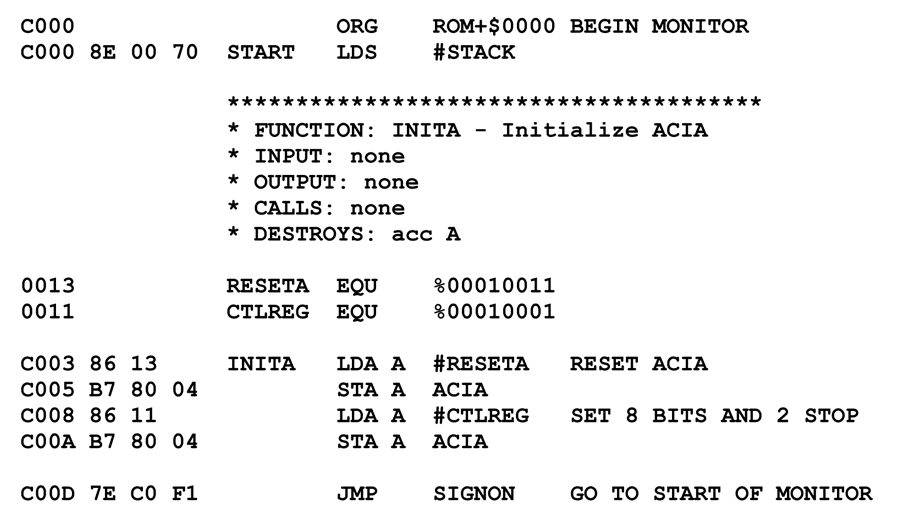
You know what’s universally regarded as un-fun by most programmers? Writing assembly language code. As Steve McConnell said back in 1994: Programmers working with high-level languages achieve better productivity and quality than those working with lower-level languages. Languages such as C++, Java, Smalltalk, and Visual Basic have been credited

By Jeff Atwood ·
Comments
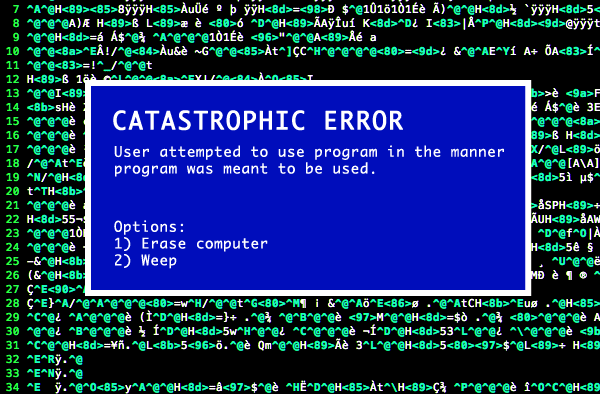
Catastrophic error: User attempted to use program in the manner program was meant to be used. Options 1) Erase computer 2) Weep

Doing Terrible Things To Your Code

In 1992, I thought I was the best programmer in the world. In my defense, I had just graduated from college, this was pre-Internet, and I lived in Boulder, Colorado working in small business jobs where I was lucky to even hear about other programmers much less meet them. I

By Jeff Atwood ·
Comments

Recent Posts

map of the United States via rgmii.org showing all 3,143 counties by rural (gold) / metro (grey) and population

Launching The Rural Guaranteed Minimum Income Initiative

It's been a year since I invited Americans to join us in a pledge to Share the American Dream: 1. Support organizations you feel are effectively helping those most in need across America right now. 2. Within the next five years, also contribute public dedications of time or

By Jeff Atwood ·
Comments
Let's Talk About The American Dream

Let's Talk About The American Dream

A few months ago I wrote about what it means to stay gold — to hold on to the best parts of ourselves, our communities, and the American Dream itself. But staying gold isn’t passive. It takes work. It takes action. It takes hard conversations that ask us to confront

By Jeff Atwood ·
Comments
Stay Gold, America

Stay Gold, America

We are at an unprecedented point in American history, and I'm concerned we may lose sight of the American Dream.

By Jeff Atwood ·
Comments
I’m feeling unlucky... 🎲   See All Posts